How Policing Has Changed (6)

There was a time when most police forces in the country had dedicated Mounted Police Sections, including the West Midlands Police. Officers who worked in these sections were highly trained specialists in their field and were worth their ‘weight in gold’ in public order situations. Affectionately known as ‘donkey wallopers’ they are included among the slang words listed in ‘One In For D & D’ which for the uninitiated means ‘One person in custody for being drunk and disorderly’. (Photos courtesy of Deb Menzel and the Express & Star)

How Policing Has Changed (5)

Our little book ‘One In For D & D’ explores more than 500 slang words, phrases and abbreviations used in the West Midlands by officers from the 1970s onward. Following the creation of the West Midlands Police in 1974, due to a number of amalgamations, the Force was known at one stage as the ‘Force of a thousand macs’ due to the sheer variety of raincoats worn. In the early 70s some officers were still even wearing capes which were extremely warm but very heavy and cumbersome. Three of their unofficial uses were being able to walk around with your hands in your pockets without being seen, holding your warm fish and chips wrapped in paper underneath without being seen, and occasionally using the cape

to swing at unruly potential prisoners to knock them off balance. (Photo courtesy of the ever helpful Deb Menzel – an icon when it comes to preserving West Midlands Police History)

‘Ta-Ra-A-Bit Our Kid’ – Born to be a Brummie

‘Ta Ra A Bit Our Kid’ is a little book of ‘Brummie’ slang designed to keep the language of Britain’s Second City alive, and to bring back memories of good times, tempered with the realisation that there were also  hard times. We might ‘talk through our noses’ and be the butt of ‘Jasper Carrott’ type jokes but ‘Brummies’ are a hardy bunch who are generally proud of their heritage. If you are not a Brummie you can’t do a proper ‘Brummie’ accent! The pictures are of one of the co-authors (Mike) and evoke memories of Wheeler Street, Lozells where he was born. Tin baths for Saturday washes and an outside toilet were the order of the day. Saturdays also meant a visit to ‘Nan’ & Grandad’s. The school uniform evokes memories of St. Silas School in Handsworth and the ride on the donkey is at West Super Mare – the traditional day out for ‘Brummies’. Both Steve and Mike are proud to have been born in Birmingham and many of their

books have strong Birmingham links.

How Policing Has Changed (4)

The historical crime fiction book ‘Keep Right On’ is set in 1976 when Birmingham City F.C. and Aston Villa F.C. played in the same Division. The story focuses on two organised football gangs affiliated to these clubs, and their fight for supremacy, but is also set against the backcloth of the rise of the political right. For those who like to research history google ‘Robert Relf’ and see what you come up with. The riots which took place outside Winson Green Prison are covered in the story-line when once again the police found themselves fighting to maintain the ‘thin blue line’ sometimes with no more than borrowed dustbin lids for protection.


How Policing Has Changed (3)

Three photos courtesy of Paul Rainey show officers at the time of the miners strike. Please note the tunics and blue shirts which were still being worn and the public order kit which was not as advanced as today. ‘Birmingham’s Front Line’ which refers to biographical accounts of

policing between 1976 to 1989 contains some recollections about officers deployed to the strike from the West Midlands. Move the clock forward to 1989 to 1997 when ‘The Noble Cause’ articulates the authors experiences of working in the police in Birmingham and Walsall.

Last chance to help us with our next book

I (Steve) am about to start putting together and proofreading our next ‘little’ book, provisionally entitled ‘It’s A Blag’. This is a book of pranks and funny stories involving Police Officers – (who do have a sense of humour – often dark though). To any of my ‘Job’ friends and colleagues who have some stories and would be willing to send them in, I would be really grateful. No matter how short or how rushed – I will sort them out and write them up. Please send to hibostinbooks@gmail.com by the end of the year. A little something you could do when you are bored after Christmas…..You will get a mention in the book and I promise the guilty will remain anonymous and the stories will be both printable and sanitised by the time they reach the page! I know there are more good ones out there and it would be a shame if they were lost forever. We are particularly light on OSU stuff – and those who were in that illustrious brigade will know what I’m talking about! Steve

How Policing Has Changed (2)

In the 1970s uniform police officers routinely wore tunics and male officers wore helmets, or flat caps if they were driving. Woe betide any officer found walking around the streets without a hat on! Whistles were worn on a chain looped into the top pocket of the tunic and a truncheon rested in a hidden pocket in the right leg of the trousers. CID officers wore suits (slightly flared trousers) and ‘sideboards’ were a common sight. How things have changed as police forces have tried to adapt to new challenges.


How Policing Has Changed (1)

Between 1997 and 2003 Mike and Steve worked at different times on the H2 Operational Command Unit which covered half of the geographical area of the Borough of Walsall. The police officers and staff who performed their duties on this area worked at four police stations namely Bloxwich, Brownhills,Darlaston and Willenhall serving local communities. The photographs shown are of the original four stations all of which had front-office counters and were open to the public. All that has now changed significantly with far less public access due to reduced staffing levels, the need to close down many local stations due to funding, and changes in technology. ‘Walsall’s Front Line – Volumes I and II’ provide

a factual history of policing in this area between 1997 and 1999. There is a little funny story about a senior officer who presented himself at the counter of Brownhills Police Station many years ago and demanded access. When the office-man queried who he was the senior officer became agitated stating, “I am the new Assistant Chief Constable with Staffordshire Police.” The officer looked at him less than impressed and said, “How do you do. I am a PC in the West Midlands Police. You are in the wrong Force area.”
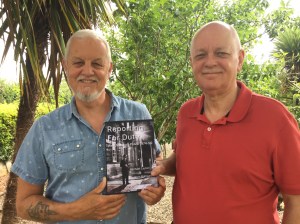
‘Violence In The Sun’ – a history of football-related violence in Cyprus

Cyprus is a beautiful island in the Mediterranean which looks east and west from its pivotal location. Sunshine, beautiful beaches and amazing scenery yet beneath the surface has lurked a problem over the years which has troubled the vast majority of Cypriots who love the ‘beautiful’ game – that of football violence. This book explores the history of violent confrontations between a minority of ‘supporters’ from a relatively small number of high-profile clubs, as well as the links to politics. An insight into a problem which has been more familiar to the streets of the UK and how the Republic of Cyprus police and Government have tried to curtail it.

Calling Cards

All of us are familiar with the concept of ‘business cards’ but at the height of violence perpetrated by gangs of ‘organized’ football hooligans in the 70s and 80s the concept took a sinister twist when gangs created their very own ‘calling cards’ which were often left at the scene of violent confrontations with opposing gangs. There were even versions with a peel-off sticky back that could be stuck on victims who had been attacked. One of the favoured weapons in the 80s was the stanley-knife which left deep and very painful injuries. Both authors have been involved in football policing over the years and some of our books reflect those experiences. In fiction terms ‘Keep Right On’ deals with two fictitious gangs affiliated to Birmingham City and Aston Villa in 1976 whilst ‘Hunting The Hooligans’ recounts the true story of a police operation to tackle Birmingham City’s notorious ‘Zulu Warriors’ in 1987. Some copies of ‘calling cards’ are attached.