How Policing Has Changed (28)

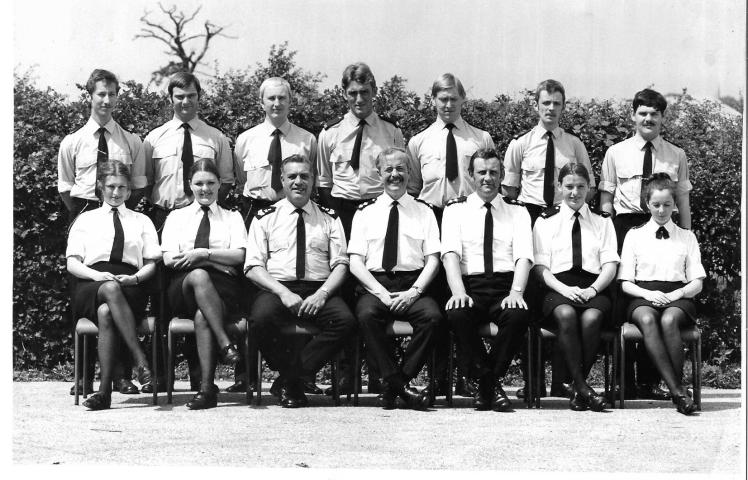
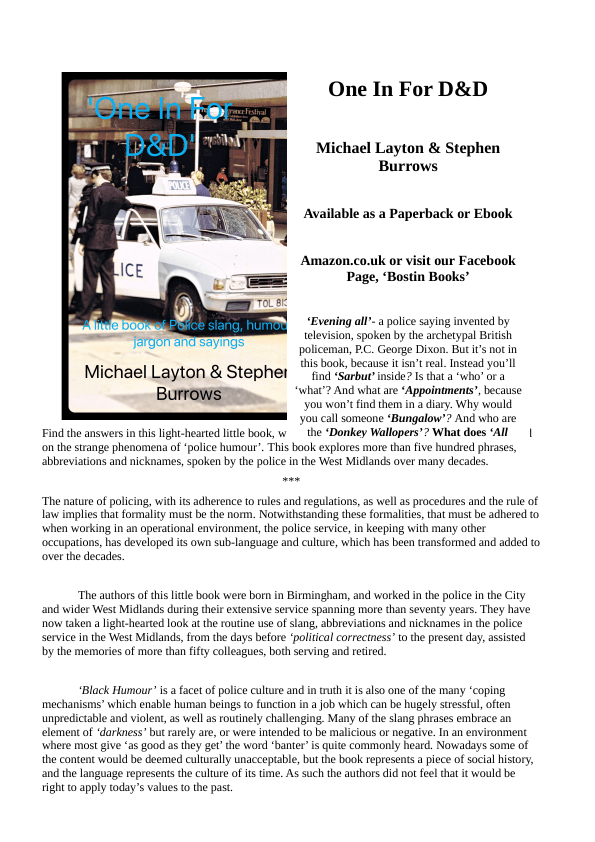
Today’s small offering is an abbreviation from our little book ‘One In For D & D’ and its ‘D.P.T.C‘ which stands for District Police Training Centre. For many years the centre at Ryton On Dunsmore near Coventry, provided initial recruit training and continuation courses for surrounding forces. Nowadays much of the recruit training is delivered locally and styles of teaching and training have changed dramatically. (The photo is from a continuation course at Ryton in the early 70s – Mike is in the picture somewhere!)wmp 1.4.18 - 1
How Policing Has Changed (27)

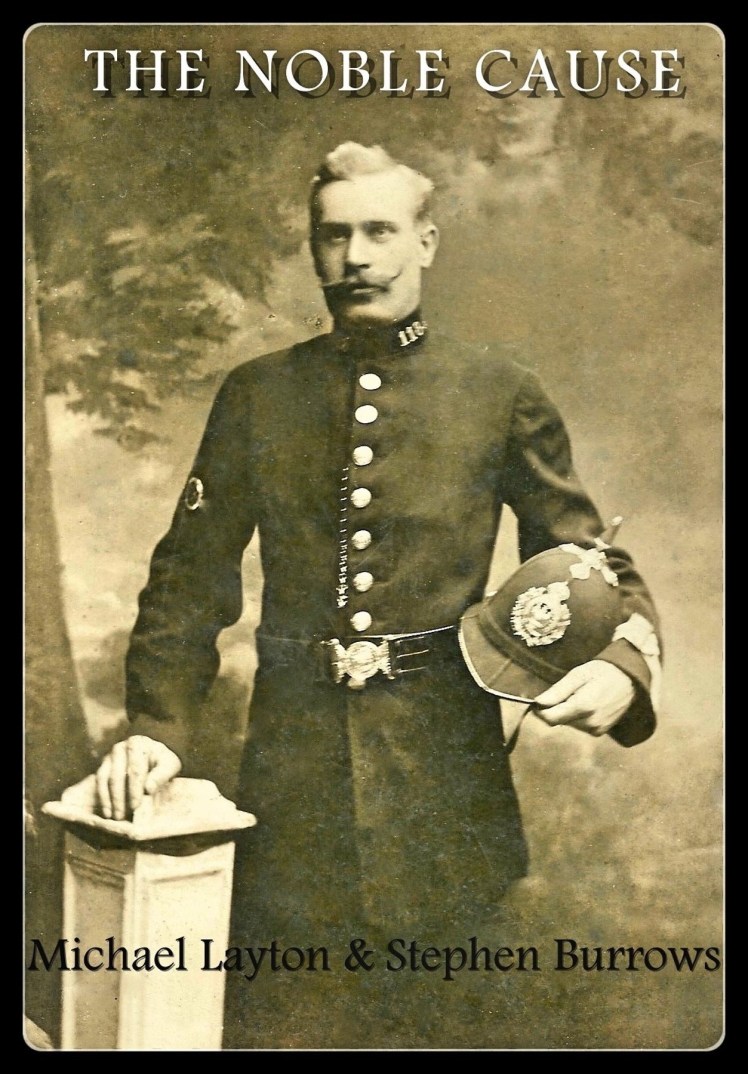
Version 5Our book ‘The Noble Cause’ begins with a citation which embodies the spirit of policing to this day albeit the circumstances of the commendation would not fit into our modern day society. Police Constable Thomas Wright from Birmingham, 29 years of age on the 13th February 1911, at great risk to his own life stopped a runaway horse in Fazeley Street. The horse was attached to a covered van carrying timber and as it galloped through streets out of control the officer bravely put himself in harms way by managing to hang onto the horses head and eventually bring it to a halt. He had been a member of the Force for nearly five years and received the princely sum of 28s 6d per week in wages. (Full details of the citation are in the book kind courtesy of his proud grand-daughter Mrs Frances Tebbutt). Every day police officers and staff somewhere in the UK perform brave tasks – not always recognised to the extent that they should be we the public nevertheless owe them a debt of gratitude.

How Policing Has Changed (26)

‘Evening all’ a police saying invented by television, spoken by the archetypal British policeman, PC George Dixon. That’s why it’s not in our little police slang book. Millions of us used to be riveted to ‘Dixon of Dock Green’ on Black and White TV sets as good normally triumphed over evil. ‘George’ was the local bobby who always tried to do the right thing, was friendly, visible, accessible and above all human. It would be naive to think that policing in today’s society could mirror that of the ‘old days’. That said has the pendulum swung too far as the need to respond quickly to so many incidents has resulted in a far more mobile policing service and tunics, helmets and ties have been replaced by combat trousers, fleeces,

T-shirts and even baseball caps in some Forces. Time and change co-exist and the Police have of necessity had to change organisationally to meet new demands – but there is still something to be said about the ‘old values’ . (Picture of unknown origin from social media)

How Policing Has Changed (25)

Informants have always played a key role in policing. Contrary to what the public might think they are generally motivated by other things rather than monetary gain although payments to informants used to be entered in ‘red ink’ in CID officers diaries in the West Midlands. On the TV informants are commonly referred to as ‘grasses’. In Birmingham and the Midlands they were called ‘sarbut’s’. The origin of the word is not clear but may be linked to the phrase ‘saboteur’. Nowadays there is a ‘posh’ word – ‘Human Intelligence Sources’. Whatever they are called they are without doubt the most cost-effective weapon in the armoury of crime investigators.One In For D & D - Flyer

How Policing Has Changed (24)

Today’s phrase from our little book ‘One In For D & D’ is ‘The Lane’. It was not uncommon in the past for police officers to spend significant periods of their service at particular police stations. Both Steve & Mike served substantial periods of time at Steelhouse Lane Police Station in Birmingham City Centre which was affectionately known as ‘The Lane’. Built for Birmingham City Police it opened in 1933 as their Central Police S

tation, replacing a Victorian station on the same site. For around sixty years it even had a licensed bar in the basement allowing officers to drink when not on duty. The station closed to the public in 2017. Unfortunately local police stations are fast becoming a thing of the past as the drive for financial cut-backs and centralisation has gripped the service.

How Policing Has Changed (23)

The British Transport Police is arguably the oldest police service in the UK. In 1968 one of the co-authors, Mike, joined the Force as a Police Cadet having been rejected by Birmingham City Police due to being ‘underweight’ – a situation he later rectified! In those days officers in the BTP had limited jurisdiction and were often referred to in not always affectionate terms as ‘the railway police’. Local Home Office forces tended to ‘rule the roost’ (Some of the photos are courtesy of BTP History Group and BTP Social Media)

particularly in respect of major incidents and murder investigations as well as terrorism. As pay and conditions, equipment, training and laws changed over the decades the BTP have increased their profile dramatically. They now play a key role in combating terrorism and in London, Birmingham and Manchester in particular you will routinely now see BTP Firearms Officers. A number of murder investigations have also been led by BTP Senior Investigating Officers and you are just as likely to see Home Office Forces requesting Mutual Aid support from the BTP in respect of large-scale public order events. The helmet badge might be different but they have stood ‘shoulder to shoulder’ with their colleagues from other Forces on numerous occasions. The BTP Dog Section was founded in 1908 and was the first in the country. The section also plays a key role in preventing terrorism and providing public reassurance. There are indeed many facets to the Force some of which are covered in the three books shown. BTP ‘characters’ also feature in both of the co-writers historical crime fiction books ‘Black Over Bill’s Mother’s’ and ‘Keep Right On’.

How Policing Has Changed (22)

‘Bostin Books’ has two core strands namely the co-authors links to Birmingham and their personal history in terms of policing in the West Midlands and elsewhere. Thus many of their books reflect that rich heritage. Often factual, sometimes fiction, the books shown seek to preserve those strong links covering decades of crime and policing, predominantly from the 1970s onward. In the factual books both the serious side of the job and the lighter moments are dealt with in an effort to show how ‘the thin blue line’ survives and prospers in a challenging environment. The historical crime fiction books thread memories of major crimes and incidents through the detailed story lines. The ‘protection of life and property’ and ‘the preservation of the peace’ remain at the heart of policing today and constables are still ‘citizens locally appointed but having authority under the Crown’. Whats changed over those decades is that the political landscape is now hugely different and the Police Service no longer attracts the unique support in terms of funding and resources that many would argue it once did. That’s why there are now far fewer officers in the UK Police Service today.

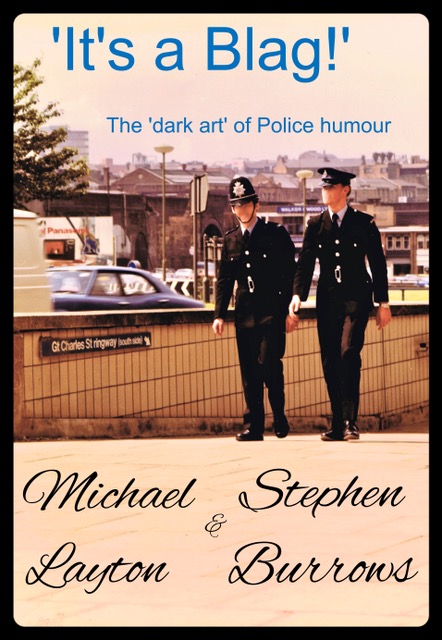
Its A Blag - Cover V1

How Policing Has Changed (21)

Today’s small offering from our little book ‘One In For D & D’ is the slang word ‘scruffies’. The term comes from the days when most police officers normally wore shirts, ties, pressed trousers and tunics, whilst police motorcyclists of necessity wore leathers and waterproofs. Highly skilled they generally had great expertise when deployed to escort duties and when ‘hunting in pairs’ there were few criminals on the roads who could outrun them. An integral part of road traffic policing unfortunately we see fewer of them about on the roads these days. The picture was taken at a community event in Walsall and the officer is a former member of the H2 Road Policing Unit, West Midlands Police wearing a tie for the occasion!

How Policing Has Changed (20)

The old Bloxwich Police Station was the epitome of how policing used to be. In the 70s and 80s most local police stations had their own cell-blocks and locally-based officers would deal with locally arrested persons in them

. Custody procedures were paper-based but not that time consuming and officers did not have to travel far. Nowadays many local police stations are being closed. Local custody facilities are a thing of the past with ‘super custody hubs’ currently in vogue, and everything is computerised. Officers have to travel further and the rules appertaining to arrest have changed so that officers have to meet a higher threshold before taking someone into custody. Therefore it is not surprising that fewer arrests are being made.

How Policing Has Changed (19)

Traffic policing has always been a core function of policing in the UK and the preservation of life through effective road safety measures, and proper education coupled  with rigorous enforcement remain laudable objectives. In 1997 local Road Policing Units (RPU’s) were set up on each Operational Command Unit in the West Midlands with twelve officers dedicated to the function. Highly trained and hugely effective they also led the way in tackling road-

related crimes such as vehicle theft. At the centre a core specialised traffic function was retained. Nowadays following cut-backs in resourcing levels and ever-changing new priorities you are far less likely to see a dedicated traffic vehicle on our roads. The sad thing is that the criminals know it and so do those who choose to flout road traffic laws.